
Prompt → output
- Weak requirement locking
- Limited runtime controls
- No structured defect-repair loop
- Little completion evidence
Acquire or license a private-deployable Agent OS that plans missions, coordinates specialized agents, controls execution, inspects artifacts, repairs defects, re-verifies results, and exports an evidence-backed proof package.
Artifact inspectionOutput examined against locked requirements
Red-team challengeWeakness and unsupported-claim checks applied
Proof packageEvidence ledger and audit trail retained
Representative buyer-safe visualization based on an internally verified Phase 7 release scenario.
Businesses and delivery teams need more than a polished answer. They need a controlled execution path, defect detection, repair, re-verification, and retained evidence showing how the result was produced.
The runtime converts a business objective and supporting files into a governed mission with traceable completion.
Public positioning begins with bounded workflows that match the system’s internal validation—not unlimited capability claims.
Business analysis, implementation planning, operational analysis, agency delivery support, and structured project packaging.
Source ingestion, weakness detection, critique, rewrite, before-and-after comparison, and repair verification.
Small-project review, technical-risk discovery, failure-point analysis, QA checklists, and fix recommendations.
Phase 7 hardens the mission loop with durable software behavior inside supported local, private, and single-tenant deployment scope.
Examine the verification gates →Expired leases and interrupted work can recover without duplicating artifact IDs.
Mission jobs, worker leases, heartbeats, priorities, and dead-letter state are retained.
Durable pause, stop, timeout, cancellation, and budget enforcement.
Health tracking and circuit-breaker decisions can route away from a failing provider.
Structured runtime events, health reporting, diagnostics, and audit visibility.
Artifacts, evidence, checkpoints, and completion records remain available for review.
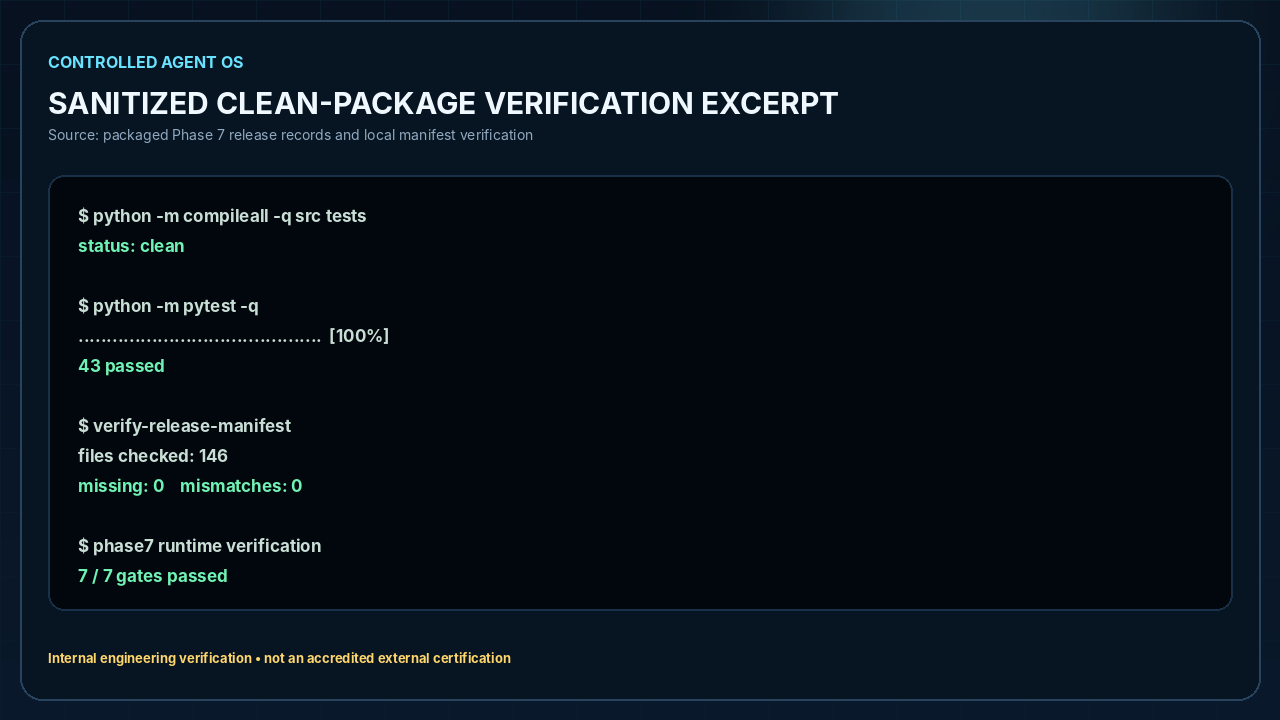
The packaged release contains 43 passing automated tests. A separate clean-package verification run reproduced all 43 passes and confirmed zero release-manifest mismatches across 146 checked files.
Durable one-click mission completes
Persistent queue records completed work
Crash recovery avoids duplicate artifacts
Pause and stop prevent new work
Budget hard-stop remains enforced
Provider circuit-breaker fallback activates
Events and diagnostic bundle available
Automated tests reproduced in clean-package verification
Five buyer-safe, text-guided walkthroughs. No audio is required; all scenarios use synthetic data or sanitized release records.
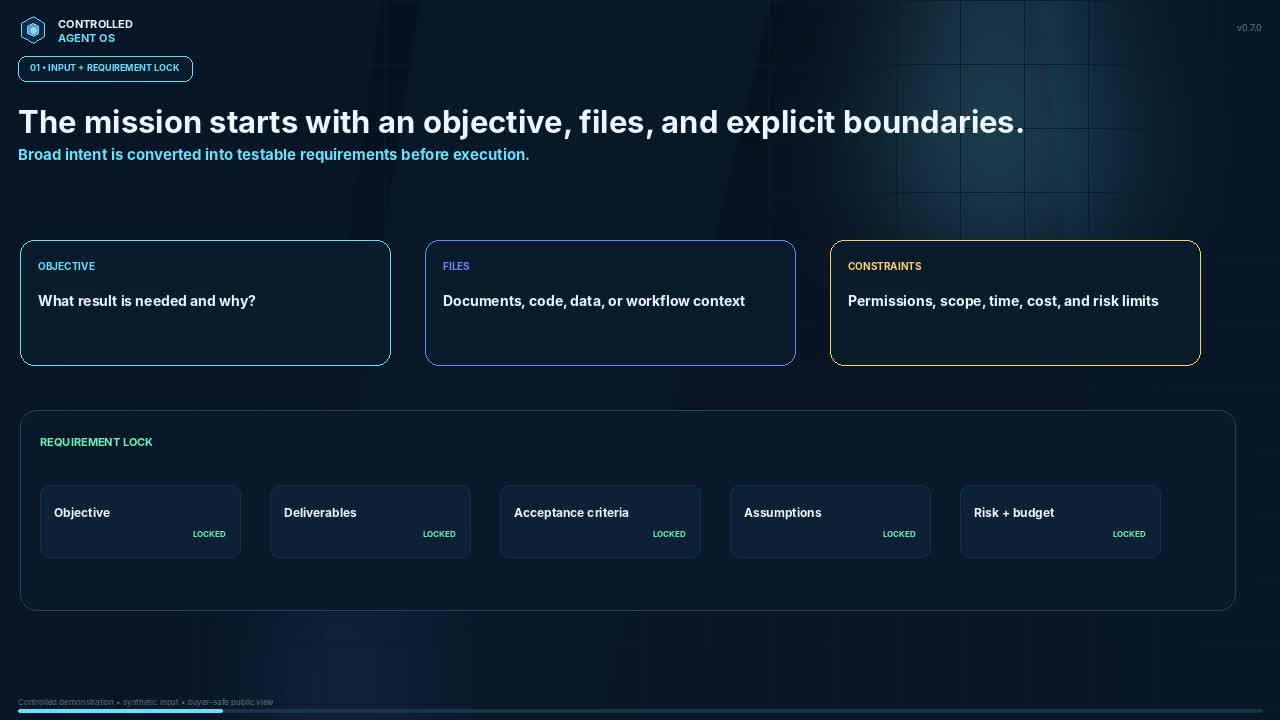
Objective and files through planning, controlled execution, inspection, repair, re-verification, and final proof export.
Read transcript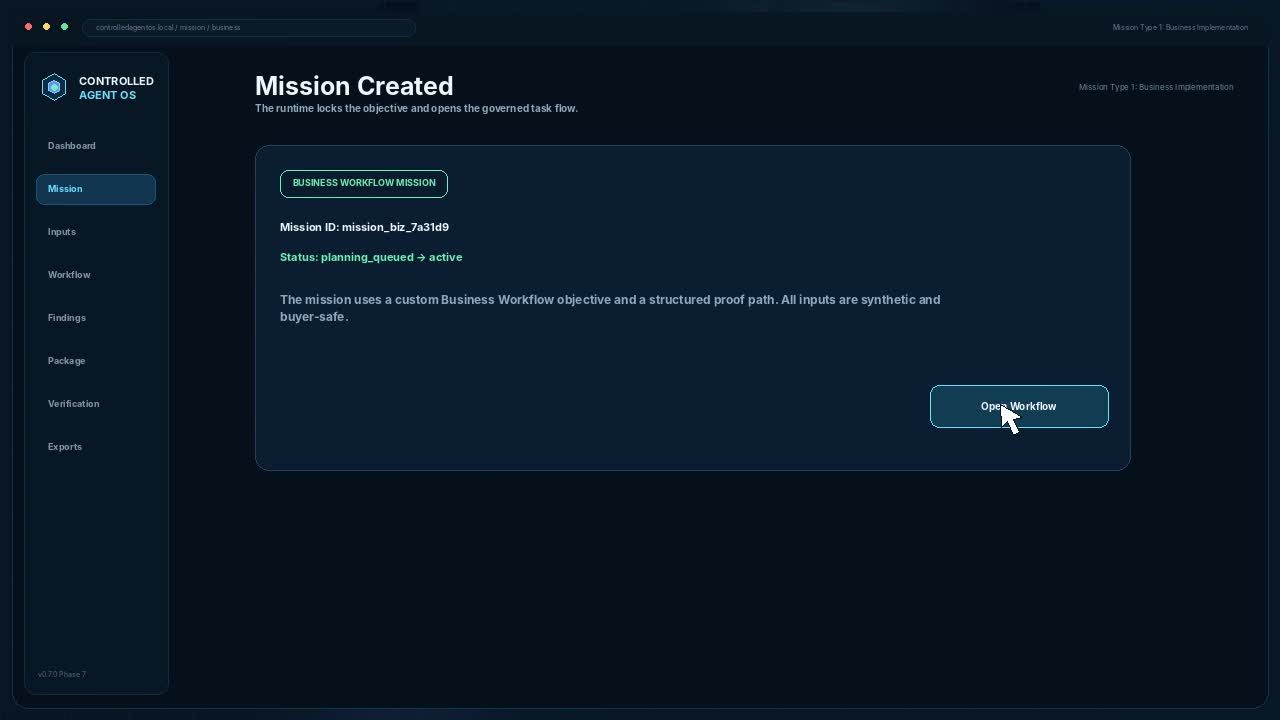
A broad objective becomes an organized, evidence-backed implementation package.
Read transcript
The system detects weaknesses, repairs the document, compares changes, and verifies the result.
Read transcript
Technical risks and failure points are converted into prioritized fixes and a QA proof package.
Read transcript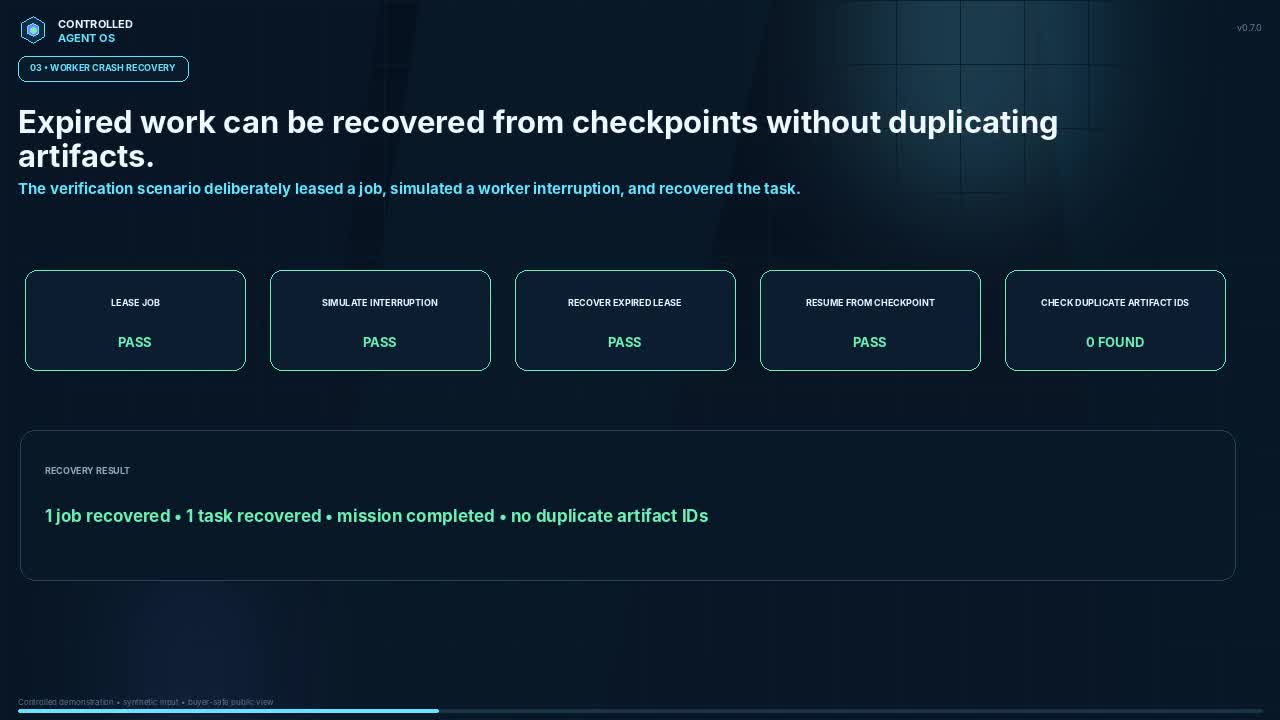
Queue persistence, pause and stop controls, crash recovery, fallback behavior, diagnostics, and proof export.
Read transcriptRequest the buyer overview and the next controlled diligence step.
The asset is positioned for acquisition, licensing, white-label deployment, or strategic productization by operators who can add distribution, vertical specialization, or customer infrastructure.
Source access is provided only through controlled diligence after qualification.
This is a Phase 7 private-deployable Agent OS packaged for acquisition, licensing, white-label use, or further productization.
It is not represented as AGI, unlimited autonomy, a mature public enterprise SaaS, or a product with established customer traction.
No. It is a software runtime with mission planning, agent orchestration, governed execution, durable queue behavior, inspection, repair, re-verification, observability, and proof-package generation.
No. Public materials are buyer-safe summaries and demonstrations. Controlled source review follows qualification and appropriate evaluation terms.
No. The package supports local deterministic testing and an OpenAI-compatible provider route. Real external-provider behavior requires the buyer’s configured credentials and a controlled smoke test.
No. It provides production-oriented durability, safety controls, recovery, observability, and proof export within supported private and single-tenant scope. Public billing, account management, organizations, seats, and support operations remain optional commercial expansions.
Request the private walkthrough, review the non-confidential overview, confirm strategic fit, then proceed to restricted proof and controlled source review.
Tell us whether you are exploring acquisition, licensing, white-label use, or strategic productization. Qualified inquiries receive the next appropriate diligence step.
Prefer email? info@controlledagentos.com